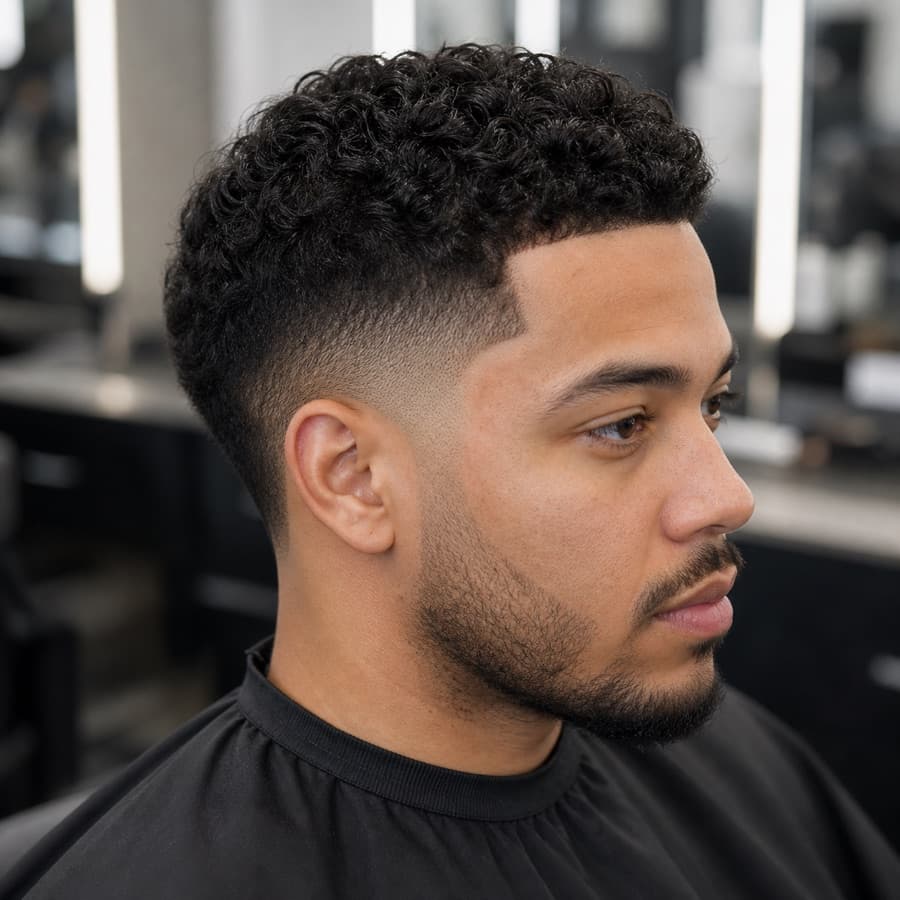
Generated illustrationtemp fade
Regular upkeepcurly + coily
Temp Fade
A temple-focused fade that sharpens the front corners without removing as much side hair as a full fade.
Illustrative only. Not a prediction or barber-reviewed reference.
Fade guide
Short for temple fade: the blend focuses on the temples and front corners while the rest of the side and back keep their length. Precision work around the hairline.
Fade names vary between shops, and the reference images in this catalogue are generated illustrations — not barber-reviewed photos. Use this guide to start the conversation, then confirm the height and shortest point in person.
What it actually means
A temp fade fades the hair at the temples — the front corners where the sideburn meets the forehead hairline. The goal is a sharp, clean corner rather than a full-side transition, which leaves the majority of the haircut untouched.
Because the work is concentrated in a small area, the cut lives or dies on line quality. Barbers often combine it with a line-up so the temple corners and front hairline read as one crisp frame.
Temp fades are common with curly tops, afro textures, and shapes where removing full-side length would ruin the silhouette — the perimeter sharpens while the volume stays.
Compare related fades
vs Burst fade
A burst wraps around the ear. A temp fade stays at the front corners and does not continue behind the ear.
vs Low taper
A low taper runs along the whole sideburn and neckline. A temp fade concentrates only at the temples.
vs Shadow fade
Shadow describes the endpoint's finish. A temp fade can be finished softly or sharply regardless of placement.
Catalogue references
Every card below uses a generated illustration with visible labels. Open one for barber wording and upkeep notes, or take it straight into a brief.
A temple-focused fade that sharpens the front corners without removing as much side hair as a full fade.
Illustrative only. Not a prediction or barber-reviewed reference.
Quick answers
Answers reflect common usage, not universal standards. Your barber's wording wins any disagreement.
Temple fade. The blending work happens at the temple corners of the hairline rather than up the whole side of the head.
It is a common pairing: the temples and corners get cleaned up while curl volume on top and through the sides remains intact.
It depends on your natural hairline and the requested outline. Point out the area before the cut so the barber can explain what can be changed without overexposing it.
Continue comparing